Looking for Mr. Ames

Working as a police officer in the early 1970’s in upstate New York, I can recall being dispatched in the middle of the night to a remote dirt road to look for an elderly woman reported wandering aimlessly in her nightclothes.  Having been sent there previously, I knew that it would be Mrs. Ames, and that she was, once again, out searching for her husband and her son … both of whom who had passed away years before. 

Given our scant knowledge of dementia at that time, it was our understanding that Mrs. Ames was “senile.”  That being so, I did what we always did … I picked her up, took her back to her home, and sought a family member to take her into their care.

Over the many years since my paltry efforts to help a disoriented woman to safety, I have come to understand that Mrs. Ames suffered from dementia … an umbrella term encompassing a broad range of brain conditions that cause a progressive decline in a person’s ability to think and remember.  What’s more, the loss of these abilities makes it increasingly difficult for people to function or care for themselves.

Today, dementia in its many forms is far better understood and, in the law enforcement community, comprehensive training is readily available for police agencies nationwide.  The International Association of Chiefs of Police, for example, provides model policies   and training curricula to prepare officers for encounters with citizens suffering from dementia, as well as checklists to follow in mounting a search for someone who may have wandered away and gone missing.

My wife, Bonnie, and I, are fortunate to reside in a community where a number of resources are available to those suffering from dementia and to their caregivers.  Just a few of the very supportive entities upon which one can call in our area include Dementia Friendly Fort Worth (dffw.org), the James L. West Center for Dementia Care (jameslwest.org), and Musical Memory Singers (musicalmemorysingers.org).  

Given the fact that one in three seniors dies with Alzheimer’s or another form of dementia, having access to support and guidance of this nature is invaluable.

As I look back some fifty years to that rural road and my interaction with Mrs. Ames (not her real name), several thoughts come to mind.  First, I hope that I treated her with dignity and compassion as I picked her up, took her back to her home, and reached out to family to care for her.  Second, I am comforted in the knowledge that first responders, today, are far better prepared than I was, to identify and assist individuals suffering with dementia.

Finally, I have boundless gratitude for the efforts of those working to find a cure for Alzheimer’s, as well as for the many groups and volunteers who provide support and guidance to individuals struggling with that awful disease, and to their caregivers.

Gail Weatherill has been a practicing RN for more than 40 years, and is a board-certified Alzheimer’s Educator.   Her poignant words are an inspiration to anyone touched by this awful disease:

Dementia care … it’s not rocket science, it’s heart science.

‘Yer Out’a Here!

Summer would not be complete without our annual trip to take in minor league baseball games.  In a tradition begun many years ago we set off, once again, to visit ballparks where we knew we could purchase seats and hot dogs for the two of us for less than it would cost to park at a major league stadium.  And, as usual, a good time was had by all.

In Oklahoma City, for example, we got a glimpse of what the future of umpiring might look like in the big leagues and, frankly, we liked it.  Major League Baseball is experimenting at the AAA level with an “automated balls and strikes” (ABS) system, which allows a batter to challenge an umpire’s strike call, and the catcher a ball.  Each team gets three challenges, but if the umpire is shown to be correct, the team loses that challenge for the rest of the game.  

Notably, each time a challenge was made in the game we attended, the video board in left center field showed the location of the pitch as determined by the electronic device and, in every case, the umpire’s call was correct.  Coupled with the “pitch clock” already in effect, this new wrinkle shows promise of making the game move even more quickly and smoothly.

While the ABS system showed us the future of officiating in baseball, the Arkansas Travelers game in Little Rock presented us with a trip down memory lane … a ballpark organ!  Listening to the beautiful strains of that instrument, I was reminded of a Florida State League game in 1985, in which the organist – Wilbur Snapp – was thrown out for playing the song “Three Blind Mice” after an umpire’s call.  

Between innings in Little Rock, I asked the organist if he knew of that event and the name of the fellow ejected.  He could not recall Snapp’s name, but he knew of the ejection … he even showed me the playlist for that evening’s game with the following warning written in large letters: DO NOT PLAY THREE BLIND MICE.

As an aside, a different ballpark organist was ejected from a game in 2012 for playing that same song, proving that George Santayana was correct in noting: “Those who cannot remember the past are condemned to repeat it.”

Growing up, I played a lot of baseball and, being a catcher, I closely followed the careers of major leaguers who excelled at that position.  One player I idolized was Smoky Burgess, who played for 18 years in the majors for several different teams.  Toward the end, Burgess was used exclusively as a pinch hitter, holding several records for excellence in that role … he would wander up to the plate, stroke a base hit, and then retire to the dugout after being replaced by a pinch runner.

With Burgess as my role model, I sometimes fantasize that I can still play the game but, unfortunately, I have yet to find a team looking for a “designated senior citizen.”  Until I find one, I will continue to be uplifted by John Fogarty’s quintessential baseball anthem “Center Field,” and those inspiring lyrics:

Put me in coach … I’m ready to play!

According to Hillary

No, not that Hillary!  

But I know what you were thinking … in the midst of a crazed election cycle, you expected another dose of political blather.  Well, not to worry for, like many, I have had it up to here with the current unceasing stream of extremist and partisan nonsense.

Instead, the Hillary referenced in the title is Sir Edmund Hillary and, more specifically, his immortal response when asked why he chose to scale Mount Everest in 1953: “Because it is there.”  For Bonnie and me, these words help explain why we decided, several years ago, to visit all the counties in the state of Texas … and there are 254 of them.  Yes, that’s right … 254 … and we did it because, well, they are there.

Since moving to Texas more than 35 years ago, we had traversed many of the state’s major highways and population areas. But with the more remote counties having eluded us, we decided to check them off … the Panhandle … the Rio Grande Valley … Deep East Texas … the Piney Woods … the Big Bend.  Our quest, no doubt, would have made Don Quixote nod with approval, but we finally pulled it off.

Along the way we met some wonderful folks, enjoyed breathtaking scenery, and partook of excellent food … the pie in Dripping Springs … the steak in Amarillo … the wine in Del Rio and St. Jo … the barbecue in Llano.  We also continued our love affair with Minor League baseball by taking in games with the El Paso Chihuahuas, the Big Bend Cowboys, the Amarillo Sod Poodles, the Midland Rockhounds, the Corpus Christi Hooks, the Frisco Roughriders and the Cleburne Railroaders.

As we rambled about the Lone Star State, we came to appreciate the  genesis of the old saying: “The sun has riz, the sun has set, and here we is in Texas yet.”  Throughout our journey, though, we remained inspired by Willie Nelson’s well-known song “On The Road Again” and, in particular, the way he describes his affection for travel: “… goin’ places that I’ve never been,” and “ … seein’ things that I may never see again.”

Willie’s joy in travel (and ours) is captured, perfectly, in the next stanza of that iconic work:

And I can’t wait to get on the road again

Lights, Camera … Wait … What?

Pre-pandemic, we were regular moviegoers.  A nearby “multi-screen” theater made it easy for us to take in a couple of shows each month but with the hysteria about social distancing and assorted other hurdles, we simply stayed away.  And though things gradually returned to normal, we continued to remain home and watch Netflix.

Recently, with outdoor temps hovering above 100 degrees, we decided that a visit to the cinema (and an air conditioned theater) might be a good way to spend an afternoon.  And though no particular movie attracted us, the prospect of watching a Hollywood production in a comfortable environment was enough to draw us in.

Before taking our seats, we visited the concession stand … who, after all, can sit through a movie without munchies?  After ordering a small popcorn and a small beverage I thought my hearing aids had failed, for it sounded like the young man behind the counter said: “That will be $17.00.”   Turns out I had heard him correctly … seventeen dollarsfor popcornand a small drink

Very carefully, we transported this precious cargo of snacks to our theater, and settled in to enjoy the show.  Before our movie began, though, we had to endure a forty minute string of “coming attractions,” each less appealing than the one before.  In the midst of this assault on our senses, we looked at each other and wondered: “Who writes and produces this stuff?”

Currently, a work stoppage by actors and writers has shut down Hollywood, leaving movie lovers and theater groups in a panic.  And though sympathetic to those struggling for fair wages, if the drivel we saw in those previews is the best the film industry has to offer, I would not object to their staying on strike permanently.

Clearly, we “Senior Citizens” are no longer the “target demographic” for companies marketing most products or, in the case of Hollywood, seeking to draw crowds to the movie theater.  In many cases, executives guiding those sorts of efforts seem to assume people our age have a 9PM curfew, along with a propensity for yelling at youngsters to: “Get the hell off my lawn.”

For the foreseeable future, Hollywood is just going to have to manage without us … though I doubt they are concerned about this.  In the meantime, Netflix and our DVD collections of Inspector George Gently and The Sopranos will have to suffice.

We plan to be in bed by 9PM anyway.

The World of Karen and Ken

Watching that video was like watching a train wreck.  I knew it was going to be ugly, but I just couldn’t look away.  

In it, a self-entitled and obnoxious woman entering a restaurant yelled at a young, minimum-wage-earning high school kid who had simply asked her to put on a face mask.  Things deteriorated quickly to the “I want to talk to the manager” stage before, in tears, the young employee told her boss that she could not put up with such nonsense any longer, and that she was quitting. 

As the young worker fled out the door, the nasty but now somewhat-subdued woman said: “OK, I will put on a mask.”  Other customers, though, having seen and heard enough, began to “boo” her.  Deciding to leave, her departure was accompanied by a chorus of: “Goodbye, Karen!” 

But wait … Karen?  How did everyone in that place know her name was Karen?

In fact, it is unlikely “Karen” is her real name.  Instead, the nickname “Karen” has come to identify that group of “adult” women unable to control their emotions when even mildly inconvenienced by store clerks, other motorists or even random passersby.  And the male of the species has a moniker as well … “Ken.”  People of this ilk are easily identified in the wild by their propensity for screaming and gesticulating … loud and long … at random individuals who, they believe, have done them some wrong.

Sadly, YouTube is replete with videos of the crazed behaviors of “Karens” and “Kens” engaging in these sorts of unrestrained public outbursts of rage over things most rational people would consider minor inconveniences … soup too hot … french fries not hot enough … checkout line too slow.  After watching some of these antics, one is left to wonder: do these people go home, look in the mirror, and feel proud of their actions?  Do they experience any shame?   And, since many of these individuals are accompanied by children, do they ever consider the sort of examples they might be setting?

In the world of public education, it should come as no surprise that record numbers of school district superintendents are throwing in the towel and moving on.  Anyone interested in knowing why this might be so should attend the next school board meeting and listen to the bitter and abusive language rained upon those charged with educating our children.  One speaker recently concluded her vituperative remarks declaring: “I will be at school on Monday with guns fully loaded.”

The airline industry, of course, has experienced unprecedented numbers of violent and otherwise uncooperative passengers refusing to comply with health and safety guidelines.  In one recent case, an international flight from Miami to London had to return to Florida because a passenger in first class refused to wear a mask.  The flight was then cancelled and everyone had to rebook on another flight … all because a self-entitled woman decided that the rules do not apply to her.  In short, this is her world, and the rest of us just happen to be walking through it.

If you have had the misfortune to witness a “Karen” or “Ken” in a full-throated rage over their belief that some service worker has failed to genuflect before them, you know how bizarre and uncomfortable something like that can be.  But as long as there is no threat of physical violence involved, it is likely a waste of time trying to calm or reason with one of those unhinged individuals.  In fact, getting attention is their goal, and it doesn’t matter whether it is good or bad attention … just so long as someone is noticing.  Frankly, when a bystander cares enough to enter their convoluted world on their terms, it is something they enjoy.

Perhaps George Bernard Shaw said it best:

I learned long ago never to wrestle with a pig. 

You get dirty and, besides, the pig likes it.

What The …

Filled with the Holiday spirit, I decided to do some last minute shopping for my lovely bride.  Walking across the store parking lot, I couldn’t help but smile at the array of Christmas shirts that caught my eye, each festooned with images and phrases celebrating this special time of year.

And then I saw it coming toward me … a garish red, white and blue tee-shirt with the words “Let’s Go Brandon” and three large letters … “FJB” … emblazoned on the front.  My immediate thought (which I kept to myself) was another three letter acronym … WTF? 

For those unfamiliar with the message on this gentleman’s shirt, the phrase “Let’s Go Brandon” is smokescreen for a vulgar insult directed at President Joe Biden (you can look it up).  And the letters “FJB” … well, you can use your imagination as to what they stand for.

By the way, I am not asserting a particular political stance here … there is, after all, ample evidence that fools, regardless of party affiliation, populate government in equal measure.  Instead, I am simply expressing wonderment and dismay at the thoughtlessness of someone who, clearly, has a bone to pick with our electoral process, while caring not a whit about others who might be offended by his sartorial messaging.  Thinking about this fellow’s audacious display I would guess that, if confronted, he would argue that he, himself, was offended by the outcome of the last election so, when it comes to his shirt, well, we can all just deal with it.

No doubt, my opinion on this matter puts me in jeopardy of being labelled a “snowflake.”  For those unfamiliar with the vocabulary of online trolls and purveyors of hate speech, that word no longer applies only to frozen precipitation that falls during the winter … today, a “snowflake” is someone thought to be overly sensitive and prone to taking offense.  If so accused, I know many will come to my defense pointing out my habit of uttering the occasional mild expletive or even conjuring up the random unspoken profanity (see “WTF” above).

So what’s the big deal?  When it is all said and done, this was only a tee-shirt, after all, and we all have far more important issues to deal with … right?

Perhaps, but consider this.  Navigating the offensive and oft-profane world in which we reside requires that we call upon a range of coping strategies to get through the day.  For example, we avoid “doom scrolling” on the Internet … we know and respect the difference between rudeness and humor … we avoid exposure to fringe news sources … and we call out and reject ignorance and hate speech. But then, despite our best efforts, we find ourselves face-to-face with – and unable to ignore – the very thing we have been struggling to avoid.

In the parking lot that day, I simply shook my head, sighed, and walked on, secure  in the knowledge that if ignorance is bliss, “tee-shirt dude” must be the happiest person alive.  Or, as Albert Einstein once said:

Only two things are infinite, the universe and human stupidity, and I’m not sure about the former.

What’s Next?

In the 15th Century, an Italian physician and lawyer by the name of Hippolytus de Marsillis wrote about a form of punishment known as “Chinese Water Torture.”    Characterized by slow but constant dripping of water on the forehead of a prisoner, the process caused fear and mental deterioration, especially when the droplets fell at random or unexpected times.  Often, the process would drive the victim insane.

Today, we are immersed in a world that de Marsillis would understand.  Daily, events find us navigating assorted threats to our health and well being while, at the same time, trying to understand and comply with often-contradictory guidance and mandates from those in authority.  This process seems relentless … new edicts issued hourly … different threats arising daily.  Somewhere, de Marsillis is watching and smiling.

For us, the modern-day equivalent of medieval torture can be seen in the fitful way we have been urged to deal with COVID … wear a mask … you don’t need a mask …it is safe to be out in public … but avoid large crowds.  And at long last, when it looked like we might be getting our hands around the whole pandemic thing … the “Delta Variant” made its presence known.  That, of course, was not sufficiently maddening … we soon learned that there is something called the “Lambda” permutation circulating out there as well.

Like many folks, we try our best to adapt and stay safe.  Preparing for a recent quick trip to the grocery store, for example, we went through our customary checklist … hand sanitizer … face masks … credit cards so we don’t have to touch actual cash.  Then, just before heading out the door we were stopped in our tracks … a news bulletin announced a new menace in our midst called “Monkeypox!”  Yes … MONKEYPOX!  In a year of medical angst, this virus – similar to smallpox – had somehow made its way from central Africa to Dallas, Texas.

Deciding, nonetheless, to chance a run for bread and milk, we ventured out.  Returning home unscathed, we breathed a sigh of relief, removed our protective gear, and settled down to watch the local news.  Any hopes for a relaxing evening were immediately dashed, though, when the broadcast led off with a report that the mosquito-borne disease known as West Nile Virus had not only shown up in our area, it had claimed its first life of the season. 

Set in a New York Police station, “Barney Miller” was a popular television show in the 1970’s and 80’s, with an outstanding cast.  One actor, Jack Soo, played the part of Detective Nick Yemana, a character known for sage and witty observations, including one that seems appropriate to the times in which we are living:

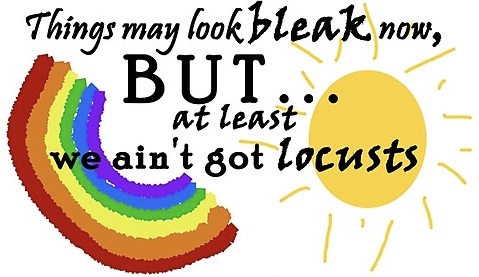
Many things look bleak at the moment of occurrence, but at least we ain’t got locusts.

We can hope that Yemana’s optimistic comment will hold true but, just in case, I am heading to Home Depot to see what they might have on hand for dealing with locusts.

Cache Us If You Can

By early 2021, we had reached the breaking point.  The seemingly endless pandemic-induced lockdown had long since lost its survivalist charm.  We had assembled (and reassembled) a plethora of jigsaw puzzles, fallen asleep while trying to find something new on Netflix, and engaged in the occasional squabble about what day of the week it was.

Clearly, we needed a breather and, since people were starting to venture out in public, we decided to “mask up” and take some cautious steps off the front porch as well.  We didn’t want to dive into the deep end right away, of course, so we looked around for something that would get us out of the house, involve some physical activity, and keep us away from crowded places.

For us, the solution was a simple one … we decided to join the multitude of others playing what amounts to the adult version of hide and seek.  Known as Geocaching, this rendition of that venerable childhood game is equal parts treasure hunt, problem solving, and outdoor exercise, and it has become our “go to” weekend pursuit.

Geocaching, as an outdoor activity, took shape in May, 2000, when  24 previously secure global positioning satellites were made available for civilian use.  With that change, folks could locate items anywhere in the world based solely on their GPS coordinates and, without a doubt, they have done so … there are now more than 3 million active geocaches hidden in 191 countries on all seven continents (even Antarctica)!

The “caches” we search for are generally small capsules or containers holding a piece of paper that, when signed, will register your find.  And though there are varying degrees of search difficulty one can select, we lean toward those that are relatively easy to locate without a great deal of extraordinary effort.  But be warned … people who hide these things can be very clever … we have found caches among the branches of trees, under rocks, and hanging from fence posts.  That, of course, is part of what makes this such an enjoyable activity.  

The process for tracking down a cache is simple: (1) check the geocaching.com web site for caches hidden in a particular area, (2) select the one you would like to look for and, (3) follow the directions on your phone or GPS device.  This will bring you very close to your goal and, usually, it is then only a very short walk (and search) before locating the cache.

In addition to the obvious benefits of being outdoors engaging in physical activity, geocaching has taken us to beautiful and unusual locations we had not previously visited, and immersed us in the fascinating history of the areas we have explored.  In short, we are smitten.

And if you are looking for us next weekend, you know where we will be.

Spam … Wonderful Spam!

Growing up, Spam was a regular part of our family cuisine.  Spam sandwiches … spam and eggs … and on special occasions, my mother would dress up a chunk of Spam with some cloves and slice of pineapple before tossing it in the oven.  When that delicacy showed up on the dinner table it was, for me, the culinary equivalent of a hickory-smoked spiral-sliced ham with all the trimmings.

Today, though, the word “Spam” has become shorthand for, among other things, the relentless barrage of unsolicited emails stretching the capacity of my inbox while offering everything from financial advice to Russian brides.  On the other hand, a recent proposal from a Nigerian prince looks promising … he promises to make me wealthy if I will just help him transfer a large sum of money out of his country.  I will let you know how that turns out.

Spam phone calls are, of course, a major problem as well but, for us, the remedy was simple … we cancelled our land-line phone.  Not only did that decision save us some money, we are also spared the deluge of political campaign calls that crop up every election cycle.  We now rely upon our cell phone caller ID which allows us to answer when we recognize a name or number, while ignoring those without an identifier.  That way, if someone wants to talk to us they leave a message and we call them back.

There is, by the way, an interesting back story about how annoying calls and emails came to be named after the famous canned meat product.  In a 1970 sketch from the Monty Python comedy series, a waitress reads aloud a menu in which every item but one includes Spam, while a chorus of patrons drown out all conversation by repeating “Spam, Spam, Spam … Lovely Spam!  Wonderful Spam!”  Thereafter, the term was adopted to describe abusive users in early chat-rooms who would flood the screen with the word “Spam” or other annoying text to drive away newcomers or prevent rival groups from chatting.  

Some clever “home remedies” for dealing with Spam calls have evolved, including one senior citizen with a talent for making his voice sound like Donald Duck.  The YouTube video of him using that famous cartoon character’s voice to talk with a Spam caller is hilarious, especially when it results in the telemarketer, in frustration, finally hanging up on him!

That priceless bit of video shows that we can have a bit of fun while deflecting nuisance callers.  To that end, I am perfecting my imitation of Woody Woodpecker in anticipation of the next person who interrupts my dinner to talk about my car’s extended warranty.

Shaking the Family Tree

If you are like us, navigating this past year has required imagination.  We have assembled a lot of jigsaw puzzles, watched hours of Netflix, caught up on our reading, and enjoyed day trips to lovely and interesting areas around North Texas.

One activity that has really captivated us, though, has been the exploration of our family trees.  An ancestry.com account has proven to be a worthwhile investment, for it has allowed us to unearth old and obscure pieces of family history, and bring renewed focus to many vaguely remembered people and events.

Fortunately, we possess a number of family genealogical documents, written records and even an oral recording of my beloved grandmother relating stories that would otherwise be unknown.   When we were able to add the trove of information from ancestry.com … photos … immigration records … grave registries … the results were fascinating.

As strong supporters of our military, we are pleased to report that men – and women – in our family have served honorably in every conflict since the Revolutionary War; sadly, some were lost in battle.  And sprinkled, liberally, among our forebears are postmasters, judges, educators, clergy and politicians.

I would like to be able to report that our ancestors descended directly and unblemished from royalty, but, unfortunately, such is not the case.  Like many families, there are a few individuals whose names, understandably, do not come up at family reunions.  And for those rascals who thought their misdeeds would remain forever hidden, well, ancestry.com and the Internet have lifted the veil. 

For as someone once said: Every family tree produces some lemons, some nuts and a few bad apples.