
Taking a Knee

Every once in a while, something extraordinary appears on Facebook. Take, for example, the powerful and eloquent post from a New York State Trooper who, ten years ago, was shot while at the scene of a domestic disturbance. In her post, she recounted the details of that awful day, and expressed her gratitude to the three officers who responded to back her up and who, after the shooter was neutralized, worked to save her life.

In this age of hyper-charged debate about what it means for an athlete to take a knee before a game, this Trooper’s post reminded me of a simple but absolute truth: police officers kneel all the time. And when they do, it is not to register their views on some social or political issue. Instead, cops take a knee because that is what the job calls for, and they do it without hesitation.

In the case of the seriously wounded Trooper, this was exactly what happened. Once the scene was stabilized, the three other officers (from two different agencies) who were there, immediately took a knee by her side, cared for her, and remained with her until she was evacuated.

As the recent tragedy in Las Vegas unfolded, pictures of the scene showed numerous police officers taking a knee next to patrol vehicles and, while under fire, scanning their surroundings to determine the location of the shooter.

Police officers responding to the scene of a serious auto accident sometimes find that they are unable to reach a trapped individual in a wrecked car until they take a knee on the pavement. Only then are they able to reach in through the twisted metal to render assistance.

Family disturbances are among the most emotional and dangerous calls for police officers. In the aftermath of those events, though, it is not uncommon for cops to take a knee to comfort a distraught young child watching a parent being led away in handcuffs.

And, far too often, police officers find themselves taking a knee at funerals, wakes and memorial ceremonies as they pay their respects to fallen brothers and sisters who have made the ultimate sacrifice.

Next weekend, the networks will gear up for the usual schedule of athletic events and much attention will be paid to whether athletes knelt or did not kneel during pre-game ceremonies. And though it will go unnoticed, this is one of those times when cops will not take a knee. Instead, with the first stirring notes of the National Anthem, every uniformed police officer in the arena will stand at attention and render a crisp hand salute.

As Americans, we do not rise and show respect for the flag and the National Anthem as a way of aggrandizing ourselves. Instead, we do so to honor, in some small way, those who have paid the ultimate price for our freedom. Police officers, who place themselves in harms way every day on our behalf, understand this better than most.

Stirring the “Pot”

Wrapping up a speaking engagement at a local high school, I had left some time for questions from the assembled students. The topic had been Woodstock and, since the students had been required to read “Dear Hippie … We Met at Woodstock: One Cop’s Memories of the 1969 Woodstock Festival,” there were a number of good questions about things like crowd size, weather conditions, music of that era and drug use.

As the class period came to an end, one young lady began to raise her hand, only to have her neighbor pull it back down. I decided to call on her for the last question anyway and, very softly, she posed one I had never been asked at a session like this: “Did you ever smoke pot?”

Whoa.

When the laughter in the hall began to subside, I thanked her for asking, and then answered truthfully: “No … at least not intentionally.” I went on to explain that the use of marijuana by concert-goers over those three days at Woodstock was so ubiquitous across the entire region that anyone within a twenty mile radius of the concert stage – including me – stood a good chance of experiencing some level of “contact high.” I was exaggerating, of course … but not much.

There is a popular aphorism concerning those who share their memories of that special time in Bethel, New York: “When someone says they remember Woodstock they probably weren’t there.” This is a sly reference, of course, to the purported negative impact marijuana use has upon memory … and it also helps explain (kiddingly) why it has taken so long to legalize pot: “The hippies kept forgetting where they left the petitions.”

With all this said, I have fond and strong memories of my time working as a police officer at this once-in-a-lifetime event. Recently, I was able to reinforce many of those recollections during a visit to the original concert site, and a tour of the lovely Museum at Bethel Woods, New York. The weather the day of my visit was pleasant, so my wife and I walked along Hurd Road … visited the meadow where it all took place … inscribed our names on a memorial … it was all good.

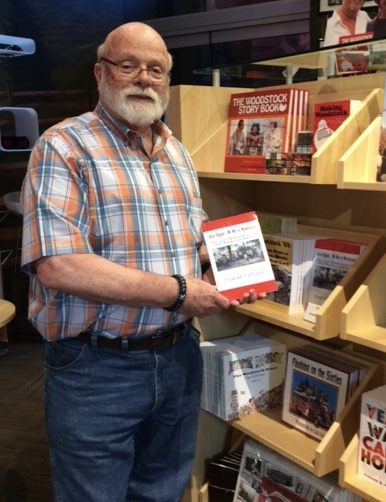
Walking through the Museum, itself, is an ideal way to get a sense of what occurred at that very location almost fifty years ago. Video presentations and static displays provide context and depth not only to the concert, but to the cultural conflict that was taking place in the United States at that time as well. We shopped around the Bindy Bazaar Museum Shop, of course, and picked up a few souvenirs … we even checked on my book! (see photo below)

In their song “Old Hippie,” the Bellamy Brothers sang of a fellow in his fifties who “dreams at night of Woodstock and the day John Lennon died,” all the while struggling to make sense of the societal changes going on around him. I suspect that many folks who came of age during the Woodstock era can understand the quandary of that old hippie trying to navigate a world he no longer understands. For me, a periodic journey back to Bethel is a refresher … a way to reconnect with a wonderful time in a truly extraordinary place.

Reflecting back on a singular event like Woodstock, I am reminded of the wisdom of Steven Wright: “Whenever I think of the past it brings back so many memories!”

Version 2

A Trip Down Memory Lane

As the calendar turns to August, I am feeling the inexorable pull to return to a place that holds genuine meaning for me … Woodstock. Yes, a family reunion in upstate New York is the purported main reason for our visit this year but, truth be told, the prospect of a visit to the Museum at Bethel Woods and the historic site that used to be Max Yasgur’s farm … well, that is really tugging at my sleeve.

The fiftieth anniversary of the iconic Woodstock Festival is a scant two years off and, though I hope to return for a sure-to-be momentous reunion, one can never predict what the future might hold. That being so, I plan to make the most of my time in this very special place this summer. Maybe a stroll down Hurd Lane … a photo, perhaps, next to the “Tomb of the Unknown Hippie” overlooking the original concert site … even an unobstructed drive along Route 17b which, in August of 1969, was jammed for miles with abandoned cars. Ah, memories!

Though named the “Woodstock Music and Arts Fair,” the event was actually held in the small community of Bethel, New York. The Museum at Bethel Woods is an excellent venue for a visit as it contains a trove of mementos and memorabilia from that iconic gathering. I am pleased that my book Dear Hippie … We Met at Woodstock is available for purchase in the museum shop so we will, of course, be stopping there as well.

Though we have lived in the state of Texas for the past thirty years, I am looking forward to our visit to New York for another important reason … it was there (in the City of Poughkeepsie) that I began my law enforcement career just over fifty years ago. While I discuss a number of my law enforcement experiences in my book, I am thrilled to have the opportunity to do a Woodstock presentation and book signing at the Adriance Memorial Library in Poughkeepsie on August 16.

The fact that I was assigned to work at Woodstock as a police officer was pure serendipity, but it was an experience that I cherish. As I look forward to visiting a place laden with rich memories, I am reminded of the 1966 song by Wayne Fontana and the Mindbenders: “Something Keeps Calling Me Back.” Indeed, something does.

Woodstock Book Now Available at The Museum at Bethel Woods

We are very excited about the recent good news that the book Dear Hippie … We Met at Woodstock is now available for purchase at the Museum at Bethel Woods in New York.  This lovely facility – which is located on the grounds of the 1969 Woodstock Festival – does a wonderful job of collecting, tending and preserving the history of that iconic event.  The setting is beautiful, and fond memories abound.  For those who were there, this museum provides a wonderful trip down memory lane (especially if memories are a bit vague).  For those who weren’t there but want to know about the event itself along with a sense of the times, this facility is outstanding.  Their site can be found and enjoyed at bethelwoodscenter.org

logo

Woodstock Memories

It has been a delightful labor of love getting to this point, and I am pleased to announce that our latest book Dear Hippie … We Met at Woodstock has been published and is now available in paperback through Amazon.  Subtitled One Cop’s Memories of the 1969 Woodstock Festival, the digital/Kindle version will also be on Amazon within the next two weeks.

bookcoverimage

Though the event took place almost fifty years ago (August 15-17, 1969), writing about my time there as a police officer brought back a number of fond memories, many of which I included in the book.  For example, while the organizers of Woodstock only planned for a crowd of about 50,000 people, an estimated half million actually found their way to Max Yasgur’s 600 acre dairy farm in bucolic Bethel, New York.  Fun fact: when the “official” tally of attendees was noted, that colossal number  made the little town of Bethel – at that moment in time – the second largest community in New York State!

Needless to say, concert organizers and government entities quickly were  overwhelmed.  With chaos seeming inevitable, catastrophe was averted through a grassroots spirit of cooperation and collaboration between Hippies and cops.  Though the few police officers assigned to work at Woodstock did a commendable job of providing essential services under very difficult circumstances, the young concert-goers, themselves, were remarkably cooperative, kind and generous.

The iconic images of Woodstock are ordinarily those of crowds, traffic jams, rain, mud … and did I mention traffic jams?  When all was said and done, though, thousands of Hippies and a handful of cops had worked together – and succeeded – in keeping things relatively calm … and peace, love and music prevailed.


The Road to Woodstock

Just finished reading Michael Lang’s book titled “The Road to Woodstock.”  Lang was one of the organizers of the 1969 Festival, and his book gave an excellent overview of all the highs (no pun intended) and lows of putting on this iconic event.  I had the good fortune to be assigned there as a member of the Dutchess County (NY) Sheriff’s Office, and it was a remarkable experience!  In his book Lang focused, primarily, on the work of contracting the bands and the plethora of other services that would be required for a gathering of this magnitude.  He also wrote of the crush of people, the traffic, the mud and a number of other things that I remember very well.  This was a good read which provided an excellent refresher on some of the details that have faded over the years.