Where Has That Half-Century Gone?

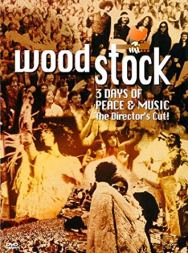
Hard to believe, but the 50th Anniversary of the Woodstock Festival is only one year away.  Many of us have, no doubt, begun to make arrangements to return to Bethel for the jubilee but, for those unable to join us, do not be concerned … this celebration is certain to be thoroughly recorded and reported upon; at least six film and documentary production groups from the United States and Europe have projects under way, with a number of print media series’ in development as well.

IMG_1511
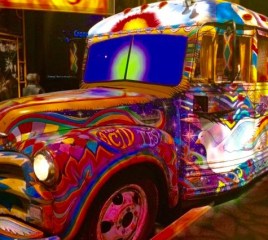
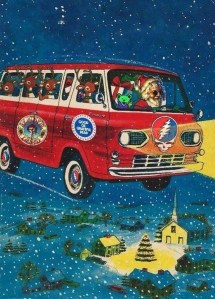
The Psychedelic Bus on display at the Museum at Bethel Woods

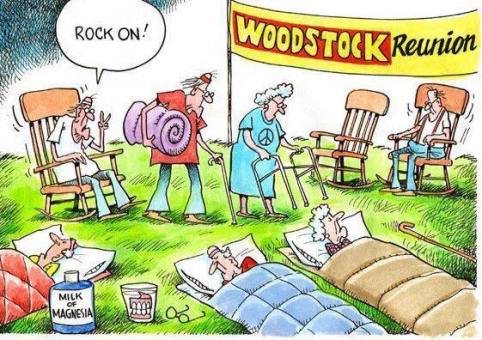
Given the certainty of wall-to-wall coverage, it might not be a bad choice to simply remain home and watch all the hoopla from the comfort of a recliner.  If you intend to show up in person, though, you will likely notice a few differences from the last time we got together in that soggy meadow in rural upstate New York:


Clothing  Tie-dyed fashions seem never to have gone out of style, but I suspect that some of us now purchase our jeans with expandable waistbands.  And while huarache sandals will surely be in evidence, many of us may opt, instead, for comfortable walking shoes.

Alcohol and Drugs  Yes, we will be drinking some wine but, given the passage of time, we will probably be consuming a goodly amount of Metamucil as well.  And when it comes to drugs, any substances we consume this time will be less “recreational” and more “therapeutic” (think cholesterol, blood pressure and arthritis).

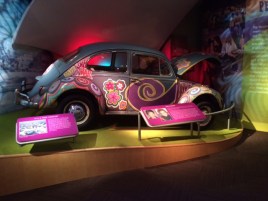
Traffic Jams  Unlike the region-wide gridlock we all endured in 1969, this time the roads will not be clogged with Volkswagen Beetles and dad’s station wagon.  Any traffic tie ups during this gathering will result from tour buses stopping to drop us off where Yasgur’s Farm used to be.

Mud   During our last get together, it was cool to get a running start and then slide in the ever-present mire.  That won’t happen this time; many of us have learned how hard it is to get back up once we have fallen and, besides, somebody could break a hip.

Public Nudity  Many of us have gained a few pounds and are less sure-footed than we were during those glorious days in 1969, so skinny dipping may be more challenging.  Be sure to take extra care climbing in and out of those local bodies of water.

So, with those cautions and nuggets of advice in mind, it is time to start some serious planning.  Somebody should call Wavy Gravy and ask him to make sure the Hog Farm bus is tuned up and ready to roll.  And for a culinary trip down “memory lane,” ask him to bring along the granola recipe he prepared as his iconic “breakfast in bed for 400,000” in 1969.

Finally, it will be important to have adequate medical services on hand this time.  Dr. Bill Abruzzi (the “Rock Doc”) achieved stardom for his treatment of “bad trips” at Woodstock and other rock concerts, but his talents (if he can even be located) may be less in demand this time.  For next year’s anniversary, organizers should line up medical staff with skills appropriate to the needs of those most likely to be in attendance … in other words, doctors with experience in geriatric medicine … who accept Medicare.

Paging Doctor Leary

Anyone who came of age during the cultural upheaval of the 1960’s and 1970’s, will likely recall the name and exploits of Dr. Timothy Leary.  An accomplished Harvard professor and researcher, he was well known for his advocacy of mind expansion drugs, with his hallucinogen of choice being LSD (Lysergic Acid Diethylamide).  Leary was also well known for his signature exhortation that we should all: “Tune In … Turn On … and Drop Out.”

When his college research with LSD was discredited by lack of scientific rigor and his failure to adhere to established protocols, Leary was banished from academia.  Not to be dissuaded, in 1966, he founded the League for Spiritual Discovery (LSD) and proclaimed it a church.  He also declared the holy sacrament of his church to be … wait for it … LSD.

Interestingly enough, LSD has been around since 1938.  Though considered, at one time, to be potentially beneficial in treating alcoholism and various psychiatric conditions, its widespread recreational use in the 1960’s resulted in prohibition (See Leary, Timothy).  Nevertheless, Leary continued to urge us to expand the capabilities of our minds through the use of LSD, a position which resulted in his being pursued, arrested, imprisoned and otherwise excoriated.

LSD (also known as “acid”) was, of course, in evidence at the Woodstock Festival in 1969.  In one memorable statement, a stage announcer named Chip Monck (yes, his real name) warned the assembled masses:  To get back to the warning that I’ve received, you might take it with however many grains of salt you wish, that the brown acid that is circulating around us is not specifically too good. It’s suggested that you do stay away from that. Of course it’s your own trip, so be my guest.

Now, here is where it gets really awkward … despite all the bad publicity at the time, Leary may have actually been on to something! 

Some recent and closely controlled studies seem to show that, in very small doses, LSD may, indeed, be of some medical benefit.  According to researchers, hallucinogens appear to “harmonize” parts of the brain that do not usually work together, meaning such drugs could potentially be useful in treating certain disorders including PTSD and chronic depression.

In early 1995, Leary was diagnosed with prostate cancer, passing away on May 31, 1996.  Near the end of his life, he looked upon death as the final trip, and outer space as the great new frontier.  On April 22, 1997, Leary’s ashes (along with those of 23 others) were lifted into space in an American Pegasus rocket.

In his novel The Colorado Kid, Stephen King put it this way: “Sooner or later, everything old is new again.”  If so, then there is little doubt that Tim Leary, that charming huckster, is smiling somewhere.

Woodstock Everlasting

The Woodstock Music and Art Fair was neither the first nor the last of a number of similar gatherings in the late 1960’s and early 1970’s.  In many ways, though, it holds a place of special significance in any discussion of the vast cultural changes so characteristic of that era.  Other concerts … Monterey … Isle of Wight … Altamont … Powder Ridge … contributed to the music and protest scene of that time, but only Woodstock has its own special and enduring brand: Woodstock Nation!

Since the initial publication of “Dear Hippie,” I have been invited to speak about Woodstock before a number of groups.  Across those sessions I met only a few folks who claim to have been in Bethel, but a vast number of others who, though not physically present, have vivid recollections of what they heard or read about those remarkable three days in August of 1969.  What I found especially impressive was that, young and old alike, people were acutely aware of Woodstock, and had a sense of what it seemed to meanIMG_1512 during that vibrant period.

While the conversation about Woodstock has allowed me to resurrect a number of fond memories, it has also shown me how deeply that singular event and that distinct period of time have touched so many people.  Clearly, if there is such a thing as a “Woodstock Nation,” its influence is felt well beyond the corporate boundaries of Bethel, New York, and is not limited solely to those with boots (or sandals) on the ground at the festival itself.  And though elusive, there is something about the texture of those three days that continues to resonate.  Having had the good fortune to be there, I suspect that it springs from the unexpected enormity of the event, and the fact that some half million people, effectively cut off from the rest of the world, persevered through an intuitive spirit of cooperation and good will.  And, yes, there was some music as well.


Some fifty years after the fact, the question remains: why does this event, originally billed as a mere music and art fair, remain so indelibly imprinted on our consciousness?  Theories abound, but Richie Havens, the first performer to take the stage at Woodstock, put it this way:  Though it’s frequently portrayed as this crazy, unbridled festival of rain-soaked, stoned hippies dancing in the mud, Woodstock was obviously much more than that or we wouldn’t still be talking about it in 2009. People of all ages and colors came together in the fields of Max Yasgur’s farm.

Nostalgia has a way of smoothing off the rough edges, so I am not surprised that those incredibly long hours, sodden fields, gridlocked roads and throngs of people seem less overwhelming today than they did in 1969.  Instead, my mind is drawn to more pleasant memories … smiling faces …  acts of kindness … expressions of appreciation … and the sense that we were involved in something bigger than all of us.  It was a very special time and place and, as the saying goes, if we didn’t do foolish things while young, we wouldn’t have anything to smile about when we are older.

For a lot of us, those days three days at Woodstock … well, they make us smile.

Of Jelly Beans, Chimneys and Such

Police officers and other first responders often find themselves working on holidays.  And while this inconvenience is understood to be “part of the job,” there is no denying that being on duty while others are celebrating with families can be difficult.

Cops, though, have a way of lightening the mood.  On Easter, for example, it was a common occurrence for the dispatcher to send a midnight shift officer to an accident where a vehicle had struck an “unknown animal.”  Further details in the radio transmission would typically run something like this: “ … uh, witnesses do not know what sort of animal but … uh, it is big and fuzzy … and, uh, there are numerous jelly beans spread around the scene.”

At Christmas, night patrol officers expected, at some point, to be dispatched to a call along the lines of: “ … report of a suspicious person on the roof … uh, caller describes the suspect as chubby and dressed in red … and, uh, he appears to be trying to climb down the chimney.”

Patrol officers had a way of getting a laugh at the expense of dispatchers as well.  Back in the “old days” when vehicle license information had to be obtained through a radio transmission to dispatch, cops would sometimes reach into their store of “special” license plates that they knew were issued to some recognizable names.

One such scenario involved an officer calling in an apparent abandoned car.  The cop would tell dispatch: “ … there is nobody around, but I found a complete set of men’s clothes on the floor of a phone booth next to the car.”  The dispatcher would then be asked to check the license plate on the vehicle which, naturally, came back to Clark Kent (the mild-mannered newspaper reporter who, when duty called, would turn into Superman).  Coincidentally, one of Clark Kent’s favorite places to change from street clothes to his superhero leotards was in a phone booth!

Another “abandoned car” prank began with a cop telling dispatch: “ … there is nobody near the vehicle, but the inside is filled with hamburger wrappers, french fry containers and soft drink cups …”  When the license plate was checked it came back, naturally, to Ronald McDonald.

The sorts of shenanigans mentioned above would, generally, take place on quiet overnight shifts when things were slow.  And while most officers looked upon these antics as harmless horseplay, there was not always universal agreement across a given shift.  Sometimes, senior officers – who wanted nothing more than radio silence – would make their views known by broadcasting on the car-to-car channel: “Knock it off … we are trying to get some sleep!”

Rightsizing … One Year Out

Wow, that year certainly went by quickly! It is hard to believe that we just passed the one-year anniversary of our effort to “rightsize” our lives but, that being so, we got to wondering how we might measure the results of our endeavor. We had high hopes, of course, that the move from a house to an apartment would be a good one but, now that we are settled in, what is our level of satisfaction?

In his book The Seven Habits of Highly Effective People, Steven Covey suggests that each of us “start with the end in mind,” and that is exactly what we did before starting down this road. In preparing for this transition, Bonnie and I discussed and settled upon who we are, what we wanted from life, and how we wanted to live now and into the future. With that established – and using that vision as our goal – we made a “leap of faith” … we sold our house, got rid of a lot of “stuff,” and moved into an Over 55 Active Retirement Community.

And the result has been better than we had any right to expect.

For example, one of our goals was to live in a comfortable and maintenance-free environment. Our apartment home surpasses all of these criteria … it is quiet, comfortable, roomy, and well-appointed. Further, on the very few occasions when a maintenance issue arose over the past year, it was handled quickly, professionally, at no cost and … here’s the best part … the work was done by someone else!

Moving to a new community always presents a range of potential social concerns: How will we connect with people? Will our new neighbors compare favorably with those we left behind? For us, any worries were erased immediately by the warm and welcoming reception we received from everyone we met. We now find ourselves among folks from a demographic niche much like ours and, to our delight, many of our new neighbors have interests and life experiences very similar to our own.

Individually, Bonnie and I have joined groups that bring us enjoyment and growth. For instance, once each week I go to breakfast with a band of ten-to-fourteen men whose backgrounds and accomplishments are amazing, while Bonnie has connected with a group of women who enjoy a variety of activities and interests. Together, we have befriended several couples with whom we enjoy going to lunch, dinner or area entertainment venues on a regular basis.

If asked to complete a satisfaction survey evaluating the way we “rightsized” our lives over the past year, we would have to rate the experience as “exceeded expectations” in every way. And while we celebrate having made this transition and what it has done for us, we continue to struggle with one nagging question:

Why didn’t we do this sooner?

“Liking” Boot Camp

Upon occasion, memories of my experiences at Air Force basic training come rushing back. In particular, I recall clambering off the bus that first brought us onto Lackland AFB in the middle of the night, and the shouted commands of a drill sergeant who ordered me to start running, telling me that I should not stop until he got tired. I don’t recall what I might have eaten earlier that evening, but I am certain that I left it along the side of road as I ran for my life in street shoes and civilian clothes. Ah, sweet memories!

The reason why this trip down memory lane resonates with me today is simple … my grandson is in US Army basic training, and he is on my mind. He is a fine young man who I know will succeed, and I have no doubt that he will be a different person when he comes back home in a couple of months. But compared to the basic training experience I remember so vividly, there is at least one significant change in how things are done today … his training company has a Facebook page!

I am sure this news will make some older veterans shake their heads, as they wonder aloud about what has become of today’s military. Facebook? What’s next, issuing an Xbox to every recruit? Or perhaps an Uber account so they can call for a ride if they are too tired to complete a training run. I have no doubt that some disaffected old salt, upon learning of this digital window into recruit training, will lament that it’s not like it was in the old days … back when ships were made of wood and men were made of steel.

For me and the rest of my grandson’s family, though, a peek at the Facebook page for his unit revealed something remarkable … young men and women becoming accomplished members of the military. I saw pictures of his unit on the obstacle course … on a march … at the firing range … and, yes, getting yelled at by drill instructors (some things, thankfully, never change). There are, of course, both good points and bad about the technology we have at our fingertips today. But being able to get a glimpse at how this young soldier and his team are doing was uplifting, encouraging and inspirational.

100px-US_Army_logo.svg

Hippie Holidays!

So anyway, I’m sitting here trying to come up with some Christmas gift ideas for my bride, when my eyes fall upon an ad for something called “Instant Pot.” Whoa! Can this really be what the name suggests? Has some genius finally designed a system for creating weed without having to go through the whole planting, cultivating, and harvesting thing?

Alas, upon reading further, the full details of the “Instant Pot” became clear … it is nothing more than a new kitchen appliance that can be used to cook a wide range of foods in a variety of ways. Sigh … well, I guess that is a pretty good idea as well.

In my defense, my initial thoughts about this product were likely driven by fond reminisces of my recent visit to the site of the 1969 Woodstock Festival, and the fact that 25299353_10155944387606730_3239219049300052954_nthe 50th Anniversary of that singular event is just over the horizon. But come to think of it, perhaps there is more to it than just that … maybe there is, as some have suggested, some sort of a magical connection between Hippies, marijuana and Christmas.

For example, what should we make of the fact that the words C-H-R-I-S-T-M-A-S and W-O-O-D-S-T-O-C-K have the same number of letters? Or that S-A-I-N-T-N-I-C-K and W-A-V-Y-G-R-A-V-Y are identical in length? What about M-I-S-T-L-E-T-O-E and M-A-X-Y-A-S-G-U-R? Are these all mere coincidences? You be the judge.

There is even some speculation that Santa, himself, may be an occasional toker. Those who take that position cite, as evidence, several of his well known behaviors that are common to regular users of marijuana. For example:

Munchies It is a well known fact that smoking marijuana creates an appetite for copious amounts of tasty and binge-worthy food. Santa loves cookies … think of how many he eats in just one night!

Forgetfulness One notable side of effect of marijuana use is the way it is said to affect memory. Santa needs to keep a list for everything and, as we know, he has to check it twice. The guy can’t even remember who’s naughty and who’s nice!

Paranoia Like many marijuana users, Santa goes to great lengths to conceal his location and even his very existence!

Always Happy Stoners readily admit that, when high, it is difficult to suppress their giggles. Santa is always smiling, laughing and generally jolly. What does that tell you?

As we all cross our fingers wondering what we will find under the tree on Christmas morning, stoners can breathe easy. In North Pole, Alaska, a member of the city council by the name of Santa Claus (yes, his real name) took exception to a recent ordinance that prohibits a marijuana business in his city. He even went public with his objection noting: “Cannabis users will not be getting coal in their stockings unless they have done some other thing that might be considered egregious.”

Hippie Holidays!

Dying to Downsize

I have to admit … the book title really caught my attention: “The Gentle Art of Swedish Death Cleaning: How to Make Your Loved Ones’ Lives Easier and Your Own Life More Pleasant.”

“Death Cleaning” … what was that all about, and what could it possibly mean to me?

Turns out the author, Margareta Magnusson, is really on to something. A resident of Stockholm, she makes the argument that “death cleaning” is not just about sorting through a deceased person’s belongings after they have passed on. Instead, she suggests this process as a permanent form of organization that can make each of our everyday lives run more smoothly.

Rightsizing … downsizing … getting rid of “stuff.” Whatever one decides to call it, the process of minimizing possessions can be liberating. And as Magnusson makes clear, undertaking this process earlier rather than later can also be a favor for those who survive us. None of us, after all, is immortal, so taking on this important task while we are still able makes perfect sense.

When Bonnie and I decided in early, 2017, to sell our house and move to a 55+ apartment community, we knew we had to get serious about winnowing through the mountain of baggage accumulated during our more than fifty years of marriage. Very quickly we determined that the most expedient way of handling this task would be to divide our possessions into four categories … take with … give away … donate … and discard.

Once we had decided upon what we would bring to our apartment, we offered the remainder to our children. We were pleased that they accepted a number of pieces of furniture, wall hangings and assorted other decorations and household items and, needless to say, we are thrilled that many of the things we have collected and loved over the years now rest in the homes of those who mean so much to us.

Magnusson’s book makes perfect good sense, and it is a delightful coincidence that Bonnie and I only recently did exactly what she suggests. Getting rid of a vast collection of unneeded items was cathartic, and is something we should have done years ago. We are pleased to report that we love life in our new apartment and community and, most especially, the reduced stress and increased personal contentment that come with living a less-encumbered lifestyle.

Taking a Knee

Every once in a while, something extraordinary appears on Facebook. Take, for example, the powerful and eloquent post from a New York State Trooper who, ten years ago, was shot while at the scene of a domestic disturbance. In her post, she recounted the details of that awful day, and expressed her gratitude to the three officers who responded to back her up and who, after the shooter was neutralized, worked to save her life.

In this age of hyper-charged debate about what it means for an athlete to take a knee before a game, this Trooper’s post reminded me of a simple but absolute truth: police officers kneel all the time. And when they do, it is not to register their views on some social or political issue. Instead, cops take a knee because that is what the job calls for, and they do it without hesitation.

In the case of the seriously wounded Trooper, this was exactly what happened. Once the scene was stabilized, the three other officers (from two different agencies) who were there, immediately took a knee by her side, cared for her, and remained with her until she was evacuated.

As the recent tragedy in Las Vegas unfolded, pictures of the scene showed numerous police officers taking a knee next to patrol vehicles and, while under fire, scanning their surroundings to determine the location of the shooter.

Police officers responding to the scene of a serious auto accident sometimes find that they are unable to reach a trapped individual in a wrecked car until they take a knee on the pavement. Only then are they able to reach in through the twisted metal to render assistance.

Family disturbances are among the most emotional and dangerous calls for police officers. In the aftermath of those events, though, it is not uncommon for cops to take a knee to comfort a distraught young child watching a parent being led away in handcuffs.

And, far too often, police officers find themselves taking a knee at funerals, wakes and memorial ceremonies as they pay their respects to fallen brothers and sisters who have made the ultimate sacrifice.

Next weekend, the networks will gear up for the usual schedule of athletic events and much attention will be paid to whether athletes knelt or did not kneel during pre-game ceremonies. And though it will go unnoticed, this is one of those times when cops will not take a knee. Instead, with the first stirring notes of the National Anthem, every uniformed police officer in the arena will stand at attention and render a crisp hand salute.

As Americans, we do not rise and show respect for the flag and the National Anthem as a way of aggrandizing ourselves. Instead, we do so to honor, in some small way, those who have paid the ultimate price for our freedom. Police officers, who place themselves in harms way every day on our behalf, understand this better than most.

Stirring the “Pot”

Wrapping up a speaking engagement at a local high school, I had left some time for questions from the assembled students. The topic had been Woodstock and, since the students had been required to read “Dear Hippie … We Met at Woodstock: One Cop’s Memories of the 1969 Woodstock Festival,” there were a number of good questions about things like crowd size, weather conditions, music of that era and drug use.

As the class period came to an end, one young lady began to raise her hand, only to have her neighbor pull it back down. I decided to call on her for the last question anyway and, very softly, she posed one I had never been asked at a session like this: “Did you ever smoke pot?”

Whoa.

When the laughter in the hall began to subside, I thanked her for asking, and then answered truthfully: “No … at least not intentionally.” I went on to explain that the use of marijuana by concert-goers over those three days at Woodstock was so ubiquitous across the entire region that anyone within a twenty mile radius of the concert stage – including me – stood a good chance of experiencing some level of “contact high.” I was exaggerating, of course … but not much.

There is a popular aphorism concerning those who share their memories of that special time in Bethel, New York: “When someone says they remember Woodstock they probably weren’t there.” This is a sly reference, of course, to the purported negative impact marijuana use has upon memory … and it also helps explain (kiddingly) why it has taken so long to legalize pot: “The hippies kept forgetting where they left the petitions.”

With all this said, I have fond and strong memories of my time working as a police officer at this once-in-a-lifetime event. Recently, I was able to reinforce many of those recollections during a visit to the original concert site, and a tour of the lovely Museum at Bethel Woods, New York. The weather the day of my visit was pleasant, so my wife and I walked along Hurd Road … visited the meadow where it all took place … inscribed our names on a memorial … it was all good.

Walking through the Museum, itself, is an ideal way to get a sense of what occurred at that very location almost fifty years ago. Video presentations and static displays provide context and depth not only to the concert, but to the cultural conflict that was taking place in the United States at that time as well. We shopped around the Bindy Bazaar Museum Shop, of course, and picked up a few souvenirs … we even checked on my book! (see photo below)

In their song “Old Hippie,” the Bellamy Brothers sang of a fellow in his fifties who “dreams at night of Woodstock and the day John Lennon died,” all the while struggling to make sense of the societal changes going on around him. I suspect that many folks who came of age during the Woodstock era can understand the quandary of that old hippie trying to navigate a world he no longer understands. For me, a periodic journey back to Bethel is a refresher … a way to reconnect with a wonderful time in a truly extraordinary place.

Reflecting back on a singular event like Woodstock, I am reminded of the wisdom of Steven Wright: “Whenever I think of the past it brings back so many memories!”

Version 2